
Tax & Regulatory
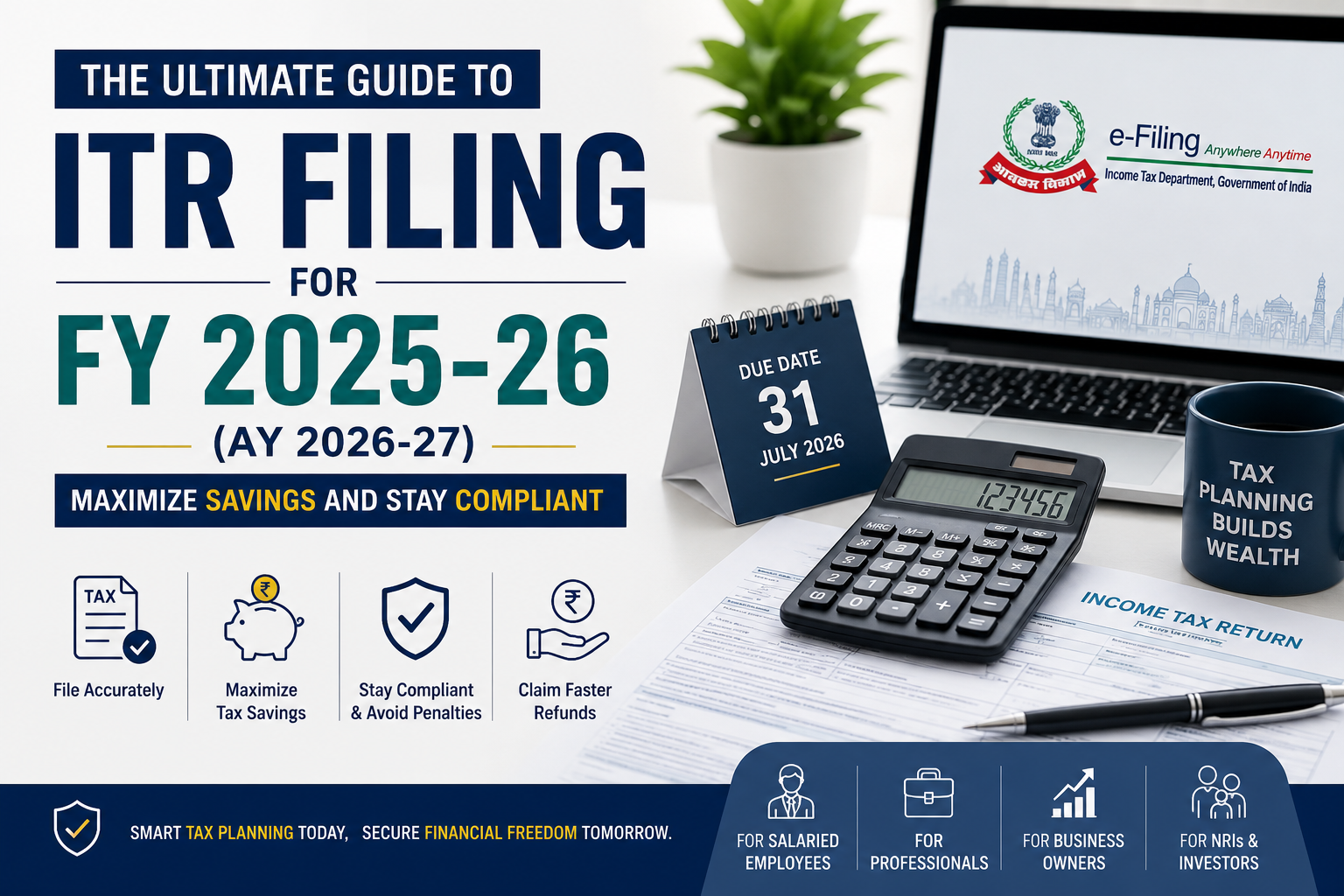
Ultimate Guide to ITR Filing for FY 2025-26 (AY 2026-27): Maximize Savings and Stay Compliant
This professional guide outlines critical updates, deadlines, and regime comparisons for Indian taxpayers filing their Income Tax Returns for FY 2025-26. It provides key compliance insights for salaried employees, freelancers, and businesses to optimize tax liability and avoid scrutiny notices
Overview
Filing your Income Tax Return is no longer a once-a-year formality you can leave to the last minute. For FY 2025-26 (AY 2026-27), the rules around regimes, rebates, and reporting have shifted enough that even seasoned filers are getting it wrong. This guide breaks down everything you need to file correctly, claim every rupee you are entitled to, and avoid the notices that come from careless mistakes.
Background / What changed
-
Transition of Legislation: This is the last filing season governed entirely by the Income Tax Act, 1961. The new Income Tax Act, 2025 takes effect from 1st April 2026, but it only applies to income earned in FY 2026-27 onward (filed in 2027). Your current return for FY 2025-26 follows the old rules.
-
Default Tax Regime: The new tax regime remains the default mechanism. If you do nothing, this is what you are taxed under.
-
HRA Changes for ITR-1: Resident individuals filing ITR-1 can now have income from up to two house properties, which is a new change this year.
-
Schedule AL Threshold: The Schedule AL (Assets and Liabilities) detailed disclosure requirement now kicks in only above 1 crore total income, up from the earlier, much lower threshold.
-
Capital Gains Overhaul: Following the Budget 2024 overhaul, short-term capital gains are taxed at 20% and long-term capital gains at 12.5%, with indexation removed for most assets. The ITR forms for AY 2026-27 reflect this unified rate structure for the entire financial year without any pre/post-July date split to track.
-
Revised Return Cutoff: A revised return under Section 139(5) can be filed until 31st March 2027 for AY 2026-27, which is an extension from the earlier December 31st cutoff.
Who is affected
-
Salaried Individuals and Pensioners: Must evaluate the enhanced standard deduction of 75,000 under the new regime versus the 50,000 deduction plus standard exemptions under the old regime.
-
Freelancers and Specified Professionals: Individuals tracking gross receipts under Section 44AA who are eligible for presumptive taxation under Section 44ADA.
-
Business Owners and Corporates: Taxpayers whose accounts require a tax audit under Section 44AB or those with transfer pricing reporting obligations.
-
Investors: Anyone with capital gains, cryptocurrency, or Virtual Digital Asset (VDA) transactions.
Key details
Deadlines and Timelines
-
31st July 2026: Due date for ITR-1 and ITR-2 filers such as salaried individuals, pensioners, and those with capital gains income where no audit is required.
-
31st August 2026: Due date for ITR-3 and ITR-4 filers with business or professional income who are not subject to audit.
-
31st October 2026: Due date for taxpayers whose accounts require a tax audit under Section 44AB.
-
30th November 2026: Extended due date for entities with transfer pricing reporting obligations.
-
31st December 2026: Last date to file a belated return with late fees and interest.
-
31st March 2027: Last date to file a revised return correcting errors in an already-filed ITR.
Tax Regime Slabs and Features
-
New Tax Regime Slabs: Up to 4,00,000 is Nil; 4,00,001 to 8,00,000 is 5%; 8,00,001 to 12,00,000 is 10%; 12,00,001 to 16,00,000 is 15%; 16,00,001 to 20,00,000 is 20%; 20,00,001 to 24,00,000 is 25%; and above 24,00,000 is 30%.
-
Old Tax Regime Slabs (Below 60 Years): Up to 2,50,000 is Nil; 2,50,001 to 5,00,000 is 5%; 5,00,001 to 10,00,000 is 20%; and above 10,00,000 is 30%.
-
Exemption Limits: The basic exemption limit is 2,50,000 for the old regime and 4,00,000 for the new regime. Senior citizen and super senior citizen exemptions remain at 3,00,000 and 5,00,000 respectively under the old regime, but align with the general 4,00,000 limit under the new regime.
-
Rebates and Deductions: The Section 87A rebate offers up to 12,500 for income up to 5 lakh under the old regime, and up to 60,000 for income up to 12 lakh under the new regime. Section 80C, Section 80D, HRA exemptions, and self-occupied home loan interest are allowed under the old regime but not allowed under the new regime. Employer NPS contributions under 80CCD(2) are allowed up to 10% of salary in the old regime and up to 14% in the new regime.
-
Switching Flexibility: Salaried individuals can switch every year. Taxpayers with business income can switch out of the new regime only once, and choosing the old regime requires filing Form 10-IEA before the due date.
ITR Form Selection
-
ITR-1 (Sahaj): For resident individuals with total income up to 50 lakh from salary, pension, up to two house properties, and other sources like interest.
-
ITR-2: For individuals and HUFs with capital gains, more than two house properties, or foreign income and assets, but no business or professional income.
-
ITR-3: For individuals and HUFs with income from business or profession under the regular method, including audit cases.
-
ITR-4 (Sugam): For resident individuals, HUFs, and firms (excluding LLPs) with presumptive income under Sections 44AD, 44ADA, or 44AE, total income up to 50 lakh, and long-term capital gains under Section 112A not exceeding 1.25 lakh.
Presumptive Taxation Framework
-
Section 44ADA: Applies to specified professionals (doctors, lawyers, engineers, architects, chartered accountants, and consultants). It allows a flat 50% of gross receipts to be treated as taxable profit. The receipt limit is 50 lakh, which extends to 75 lakh if at least 95% of receipts are digital.
-
Section 44AD: Applies to other businesses with a turnover limit of 3 crore and a deemed profit rate of 8% (or 6% for digital receipts).
-
Books of Account: Taxpayers do not need to maintain detailed books or undergo an audit if they declare income at or above the presumptive rates. If they declare lower profits, full books and a tax audit become mandatory.
-
Advance Tax: Presumptive tax filers must pay 100% of their advance tax by 15th March of the financial year to avoid interest under Sections 234B and 234C.
Common Compliance Pitfalls
-
E-Verification Window: Returns must be e-verified via Aadhaar OTP, net banking, or other modes within 30 days of submission, or the return is treated as never filed.
-
AIS and TIS Mismatches: Failing to reconcile the return against data captured in the Annual Information Statement and Taxpayer Information Summary triggers automated mismatch notices.
-
Form 10-IEA Omission: Business taxpayers who fail to file Form 10-IEA before the due date are automatically blocked from using the old tax regime.
-
Virtual Digital Assets: Gains from cryptocurrency and NFTs are taxed flat at 30% with no deductions except acquisition cost. VDA losses cannot be set off against any other income head.
-
Pre-Filled Data: Auto-populated data from the e-filing portal must be verified against personal records to avoid flowing third-party errors into the return.
-
Late Filing Penalties: Missing the main deadlines results in a Section 234F late fee of 1,000 (if income is below 5 lakh) or 5,000 (for higher incomes), along with interest and the loss of the old regime option and loss carry-forwards.
-
Updated Returns (ITR-U): Section 139(8A) allows voluntary disclosure of omitted income up to four years from the end of the relevant assessment year, but incurs additional penalties up to 5,000 and bars fresh deduction claims.
What you should do
-
Reconcile Income: Cross-check all personal financial records against the auto-populated data in the AIS, TIS, and Form 26AS before accepting pre-filled inputs.
-
Identify Correct Form: Select your filing form carefully between ITR-1, ITR-2, ITR-3, and ITR-4 based on your specific revenue streams and asset thresholds.
-
Evaluate Regimes Annually: Perform an exact mathematical calculation comparing the old and new tax regimes rather than relying on generic calculators, especially if you have home loans or HRA.
-
File Form 10-IEA: Ensure that Form 10-IEA is formally submitted prior to the ITR due date if you have business income and wish to opt out of the default new regime.
-
Establish Presumptive Status: Confirm whether your consulting work fits under the specified professions of Section 44ADA (50% profit rate) or regular business under Section 44AD to avoid misclassification.
-
Pay Self-Assessment Tax: Clear any balance tax liabilities before hitting the final submission button.
-
Complete E-Verification: Set an immediate calendar reminder to e-verify the submitted return within the mandatory 30-day window.
How Dewberry Advisors can help
-
Regime Optimization: Our team runs parallel calculations utilizing your exact financial data to protect you against choosing the wrong tax regime.
-
Deadline Tracking: We manage your compliance timeline so that you never lose crucial deductions or carry-forward benefits to missed dates.
-
Presumptive Taxation Architecture: Our specialists structure filings for freelancers and consultants to legally minimize liability while maintaining proper alignment between Section 44AD and 44ADA.
-
Pre-Filing Audit and Review: We review your draft return alongside your AIS and TIS records to intercept third-party errors and prevent expensive automated mismatch notices before submission.
Need help applying this to your business?
Book a consultation with our specialists for advice tailored to your situation.